Agentic Systems & Edge Compute: The Dual Forces Reshaping Enterprise Infrastructure in 2026
Updated: November 1, 2026
13
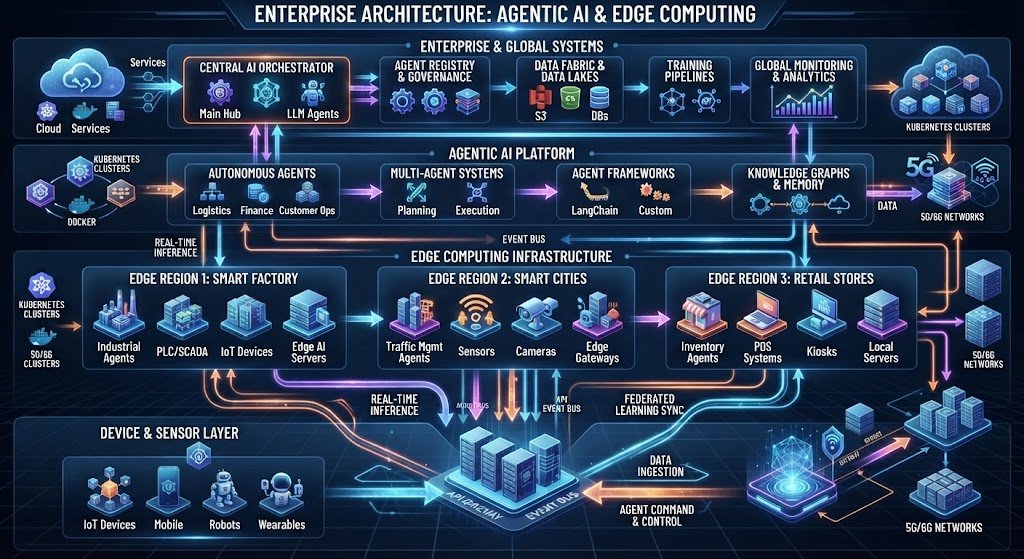
Discover how autonomous AI agents and edge inference are transforming enterprise architecture in 2026. Explore key deployment models, latency benchmarks, security frameworks, and real-world ROI.
Introduction
For years, enterprise IT teams focused almost entirely on single-turn AI outputs: building better prompts, scaling model parameter sizes, and querying centralized cloud endpoints. But in 2026, that architecture is hitting a hard wall. High API latency, escalating cloud egress bills, and strict regional data governance mandates have forced engineering teams to rethink where and how intelligence operates.
The solution isn’t just building bigger models in central data centers—it’s decentralizing execution entirely. By pairing agentic AI workflows (systems that plan, evaluate tools, and execute multi-step tasks) with localized edge compute, organizations are moving from reactive chatbots to real-time, autonomous infrastructure.
In this deep dive, we break down how agentic logic and edge inference intersect, why traditional cloud setups are failing high-throughput applications, and how system architects can build low-latency agent pipelines that perform reliably in production.
1. Moving Beyond Prompt-and-Response: The Rise of Agentic Workflows
The defining shift in modern software design is replacing passive text generation with goal-driven orchestration. Traditional generative setups require a human user to drive every iteration. Agentic systems, on the other hand, maintain persistent context, evaluate incoming data against set goals, select appropriate APIs, and handle errors on the fly without constant human oversight.
What Makes Agentic Architecture Different
- Dynamic Task Deconstruction: High-level goals are broken down into sub-queries and executed sequentially or in parallel based on real-time feedback.
- Deterministic Tool Invocation: Rather than simply generating conversational text, agents trigger structured REST, GraphQL, or gRPC functions using pre-defined schema constraints.
- Self-Healing Execution: When an API returns a non-200 response or malformed payload, the agent re-evaluates its state, corrects the parameter inputs, and retries the call autonomously.
2. Why Centralized Cloud Infrastructure Is Failing Agent Loops
Running multi-turn agent loops through centralized cloud providers introduces bottlenecks that degrade user experience and inflate operating budgets:
- Compounding Network Latency: An agentic workflow requiring 5 to 10 sequential function calls across a central cloud API creates cumulative round-trip delays—turning what should be a split-second task into a multi-second wait.
- Bandwidth Costs: Streaming raw, uncompressed sensor feeds, telematics, or video streams back to a central cloud facility for inference is financially unviable at enterprise scale.
- Data Sovereignty Constraints: Strict privacy laws increasingly prohibit sending raw user data across geographical boundaries. Processing must occur locally at the perimeter.
Deploying small, specialized language models (SLMs) to regional points of presence (PoPs) or local edge gateways solves these friction points. Inference speeds drop to single-digit milliseconds, and only essential telemetry or summarized results are pushed back to core cloud storage.
3. Real-World Industry Use Cases
Deploying autonomous agentic AI at the edge moves enterprise infrastructure from passive observation to active operational execution across key verticals:
Smart Manufacturing & Industrial Automation
- Predictive Maintenance & Closed-Loop Control: Instead of sending telemetry back to a centralized cloud for batch analysis, localized edge agents monitor vibration, thermal telemetry, and motor resonance in real time.
- Autonomous Defect Correction: When high-speed vision sensors spot a machining drift on an assembly line, an edge micro-agent dynamically recalibrates sub-millimeter tooling or diverts defective parts instantly, maintaining sub-5ms latency without interrupting factory throughput.
Retail & Smart Shelf Orchestration
- Automated Stock Tracking: Computer-vision edge nodes paired with localized inventory agents monitor micro-level shelf availability.
- Dynamic Pricing & Shrinkage Prevention: When stock dips or fraudulent behavior is detected at point-of-sale (POS) terminals, retail agents independently initiate local restocking tasks, update digital shelf labels, or alert floor staff—processing all customer video feeds locally to maintain strict privacy compliance.
Logistics & Autonomous Fleets
- Edge Routing in Degraded Connectivity: Autonomous mobile robots (AMRs) in distribution centers and long-haul delivery vehicles rely on decentralized agent fleets.
- Collaborative Fleet Orchestration: If network connectivity to the central cloud drops, peer-to-peer edge agents negotiate spatial paths, optimize route priorities, and execute warehouse sorting locally without central cloud dependency.
4. The Hybrid Edge-Cloud Continuum Architecture
Modern enterprise AI architecture avoids a binary choice between pure cloud or pure edge; instead, it relies on a coordinated division of labor across the edge-cloud continuum.
- The Cloud (“Big Brain”): Functions as the centralized intelligence hub. It handles heavy global model training, aggregates cross-site data telemetry, manages agent registries, and runs long-term business logic and heavy compliance audits.
- The Edge Micro-Agents (“Reflexes”): Handle real-time perception, goal-oriented decision-making, and immediate action. Lightweight models running on local nodes maintain sub-10ms latency.
- Inter-Layer Synchronization: Edge agents execute actions locally and push only compressed, sanitized metadata back to the cloud. The cloud periodically pushes updated model weights and revised governance boundaries down to the edge nodes.
5. Architectural Performance Benchmarks
|
Architectural Metric |
Centralized Cloud Setup |
Edge-Enabled Agentic Architecture |
|---|---|---|
|
Average End-to-End Latency |
800ms – 2,200ms |
45ms – 120ms |
|
Data Ingestion Cost |
High (Unfiltered Egress & Metered Calls) |
Low (Data filtered at the perimeter) |
|
Offline Capabilities |
Zero (Requires active WAN link) |
High (Operates via local cached models) |
|
Compliance Risk |
High (Multi-region data transfers) |
Low (Raw data stays on local edge node) |
6. Security, Governance, and Trust Frameworks
Granting autonomous systems operational authority at the physical or digital edge requires robust guardrails to prevent unmitigated agent failure:
- Zero-Trust at the Edge (ZT-Edge): Every edge agent is treated as an untrusted micro-service. Autonomous actions (e.g., executing an API call to a physical controller or initiating transactions) require cryptographic authentication, short-lived tokens, and strict dynamic permission boundaries.
- Human-in-the-Loop (HITL) Guardrails: To prevent runaway execution loops, systems operate under deterministic policy layers. If an agent’s confidence score falls below a threshold or an action exceeds pre-approved parameters, the system halts execution and defers to human oversight.
- Data Sovereignty & Local Compliance: By keeping raw operational and customer data processing strictly on localized edge hardware, enterprises inherently comply with strict regional data sovereignty laws (such as GDPR or EU AI Act provisions).
- Auditing & Decision Traceability: Agentic workflows maintain append-only, tamper-evident transaction logs at the edge to track every step of an autonomous decision-making process for post-event forensic auditing.
7. Hardware & Compute Realities (2026 Benchmarks)
Running multi-agent systems at the edge has moved from theoretical design to practical reality due to rapid hardware advances:
- Specialized Edge Silicon & NPUs: Modern edge hardware features dedicated Neural Processing Units (NPUs) and compact System-on-Chips (SoCs) tailored for low-power, high-throughput local AI inference.
- Quantized Micro-LLMs & SLMs: Efficient Model Compression techniques (4-bit and 8-bit quantization) allow multi-billion parameter Small Language Models (SLMs) to run smoothly on edge servers with minimal energy overhead.
- Bandwidth & Latency Decoupling: Local hardware execution eliminates reliance on continuous, high-bandwidth cloud connections, allowing remote facilities to remain operational even during severe network outages.
8. Tactical Engineering Steps for System Architects
If you are planning an agentic edge rollout on your platform, consider this implementation blueprint:
- Distribute Model Workloads: Use frontier cloud models (such as Claude 3.5 Sonnet or GPT-4o) exclusively for high-level reasoning and strategic orchestration. Offload execution, data filtering, and routine tool calls to quantized small language models (like Llama-3-8B or Phi-3) running directly on edge hardware.
- Strict Schema Standardization: Enforce rigid OpenAPI or JSON Schema contracts across every internal service your agents interact with to prevent runtime parser errors.
- Perimeter Sandboxing: Implement strict execution guardrails, rate-limiting, and timeout limits around autonomous steps to prevent rogue execution loops or unauthorized system mutations.
Key Takeaways for 2026 Infrastructure Strategy
- Decentralizing AI execution from central cloud hubs to edge nodes dramatically reduces latency (from 2,200ms down to sub-120ms loops).
- Edge micro-agents handle immediate operational actions, while the central cloud retains high-level governance, global training, and heavy analytics.
- Establishing zero-trust permission models and hardware-accelerated local SLMs is essential for secure, resilient production deployments.
Please Write Your Comments